


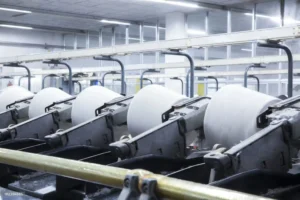
If you want to start a textile company, you are entering a massive global market that buys and sells all kinds of fabrics. At the heart of this industry are the textile mills. These mills take raw materials and magically transform them into fibres, yarns, and threads.
To understand the basics, you just need to know that “yarn” is simply a group of fibre strands spun together. People use this yarn to weave or knit the fabrics we use every day.
Manufacturers pull materials from four main natural sources to create these textiles:
- Animals: Things like wool from sheep or silk from worms.
- Plants: Materials like cotton, bamboo, flax, and jute.
- Minerals: Resources like glass fibre and asbestos.
- Synthetics: During the 1900s, scientists learned how to make artificial fibres from petroleum. Today, we widely use these synthetic materials, such as polyester, nylon, acrylic, and rayon.
Why Pakistan is a Great Place for Textiles
The textile industry truly powers Pakistan’s economy. In fact, it is the largest production sector in the nation. It creates a massive 57% of everything the country exports to the rest of the world.
Beyond just making money, this industry keeps the country running by providing jobs. It employs roughly 40% of the national workforce and adds a solid 8.5% to the country’s Gross Domestic Product (GDP). To give you an idea of its massive size, experts valued the entire sector at 7.72 billion US dollars back in early 2018.
Exploring the Main Branches of the Industry
Different specialised sectors work together to build the whole textile industry in Pakistan. If you enter this business, you will likely work in one of these major areas:
- The cotton spinning sector
- The cloth manufacturing sector
- The “made-up” sector (which creates finished goods like towels, tents, bags, bed sheets, socks, and ready-to-wear clothing)
- The synthetic fibre sector
- The filament yarn sector
- The art silk and synthetic weaving sector
- The woollen industry
Overcoming Hurdles and Bouncing Back
Every industry faces tough times, and the textile sector recently hit a few speed bumps. Factory owners struggled with power outages, gas shortages, wild changes in thread prices, a drop in the local currency’s value, and a general lack of modern technology.
However, things took a very positive turn toward the end of 2020. When Pakistan ended its strict lockdown in May of that year, it gained a huge advantage. Global buyers immediately sent their orders to Pakistan because rival exporting countries, like India and China, still had their factories locked down. On top of this, the Pakistani government stepped in with fresh incentives and made it much easier for local companies to export their goods.
The Government’s Big Plan: Textile Policy 2020-2025
In March 2020, the government shared an exciting new roadmap called the Textile Policy 2020-2025. They designed this plan to push textile exports up to 28 billion dollars over five years.
Here are the exciting steps the government plans to take to help business owners:
- They will lock electricity prices at 7.5 US cents per kWh and gas prices at $6.5 per MMBTU for five years, so factories can predict their bills.
- They will build brand new Specialised Economic Zones.
- They will help farmers grow better quality cotton and produce more of it.
- They want factories to use more Man-Made Fibres (MMF). Right now, the industry uses 70% cotton and 30% MMF. The government wants to balance this to a 50:50 ratio.
- They will make the paperwork for temporary import programs much simpler.
- They will allow businesses to easily transfer unfinished goods between different bonded warehouses and importers.
- They will review the old tax rules (specifically the SRO 1124 zero-rating rule).
- They will set aside at least 1 billion dollars every single year to give out long-term business loans.
- They will refund local taxes and fees to the people who make garments and finished goods.
- They will drop the minimum turnover tax from 1.5% down to 0.5%. They will also give indirect exporters the exact same tax benefits that direct exporters get.
(Note: The official cabinet still needs to give its final approval before this policy fully goes into effect.)
Step-by-Step Guide: How to Legally Register Your Business
In Pakistan, starting up a brand-new textile company is surprisingly easy in the process. You do not need to chase down extra licenses or join any special trade associations. You simply need to register your business with two main government offices. The Securities and Exchange Commission of Pakistan (SECP) and the Federal Board of Revenue (FBR).
Phase 1: Dealing with the SECP
The SECP acts as the official referee for the corporate world. They handle the creation of all private and public companies. You will go through three easy steps with them:
Step 1: Reserve Your Company Name: First, you must pick a great name for your business that follows the rules of the Companies Act 2017. You need to give the SECP three name choices. You can ask them to approve your name first, or you can submit your name choices at the same time you hand in your main company application. If you submit the name choices with your main application, you pay no extra fee. If you ask for name approval separately online, you pay a small fee of 200 rupees. If you hand in a paper application for the name, it costs 500 rupees. The official registrar will check your names. If they approve one, they will hold that name for you for 60 days. You must finish registering your company before those 60 days run out.
Step 2: Submit Your Official Application: Next, you apply to officially create your company. The fee you pay depends entirely on how big your company is and how much money you plan to invest. You will need to attach these documents to your application:
- A Memorandum of Association signed by the business founders. (If you use paper forms, you must stamp this according to the Stamp Act of 1877.
- An Articles of Association signed by the founders.
- Copies of the ID cards (NIC or NICOP) for all founders, directors, and the CEO.
- A copy of a witness’s ID card (only needed for paper applications).
- A stamped letter giving someone permission to hand in the paperwork for you (only needed for paper applications).
- The original bank receipt showing you paid the fees (only needed for paper applications).
Step 3: Receive Your Certificate: Once you give everything to the SECP Registrar, they will review your file to ensure you followed all the rules. Once they feel satisfied, they will officially record your documents. Finally, they will hand you your Certificate of Incorporation, complete with an official signature and seal. Your company now legally exists!
Phase 2: Getting Your Tax Number from the FBR
In the past, business owners had to visit the FBR separately to apply for a National Tax Number (NTN). Today, the government has made life much easier. The SECP now uses a “one-window” system. This means the SECP automatically sends all your new company details straight over to the FBR. The FBR then processes your tax registration behind the scenes, saving you a lot of time and hassle.